
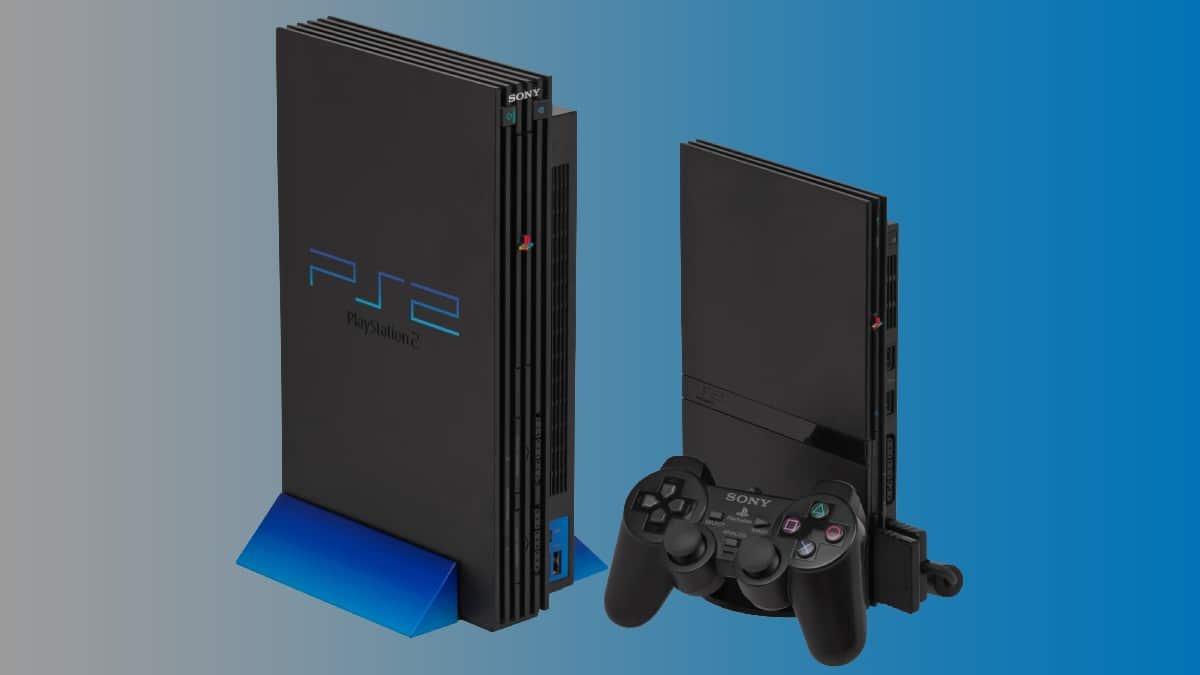
The PlayStation 2 was not one static console. Across its 2000–2013 lifespan, Sony released multiple PlayStation 2 console models with meaningful changes to their chassis, motherboard design, optical drive, cooling, ports, networking, storage expansion, and power supply.
For a casual player, nearly every PS2 can play a large PS2 library. For collectors, retro-gaming buyers, and hardware enthusiasts, though, the specific model can matter a great deal. A launch-era Japanese SCPH-10000 is historically important but unusual. A late “fat” console can support official hard-drive accessories. An early Slimline has different networking and storage characteristics than a later SCPH-90000 Slim. Even two consoles that look nearly identical may contain different internal boards and components.
This guide covers the major PS2 hardware eras chronologically, explains Sony’s SCPH model-number system, and helps collectors identify the trade-offs between PS2 fat and slim systems.
This article contains affiliate links. As an Amazon Associate, Console Canyon earns from qualifying purchases. Learn more.
PS2 models at a glance:
- Fat models: SCPH-10000 through SCPH-50000 (2000–2004)
- Slim models: SCPH-70000 through SCPH-90000 (2004–2013)
- Find your model: check the SCPH label on the underside or rear of the console
- Official hard drive support: fat models with the rear Expansion Bay (SCPH-30000 through SCPH-50000)
- Simplest late model: SCPH-90000, the only Slim with an internal power supply
Table of Contents
Understanding PS2 SCPH Model Numbers
Sony identified most retail PlayStation 2 hardware using the format SCPH-xxxxx. “SCPH” was Sony’s long-running product-prefix convention for PlayStation hardware, while the digits identify a model family and regional variation.
At a high level:
- Lower-numbered PS2 SCPH models are generally earlier systems.
- SCPH-10000 through SCPH-50000 families are the original larger “fat” PlayStation 2 designs.
- SCPH-70000 through SCPH-90000 families are the smaller PS2 Slim models.
- The final digit or digits often identify a regional version, but this is not a universal one-digit rule across every market and production run.
- Regional variants can differ in power requirements, video standards, bundled accessories, modem support, printed labeling, and software-region compatibility.
A common example is the relationship between Japanese and North American models:
- SCPH-50000 is a Japanese late-generation fat PS2 family.
- SCPH-50001 is associated with the North American version of that family.
- SCPH-50004 is commonly associated with a European/PAL version.
However, collectors should avoid treating every trailing digit as a complete regional decoder. Sony used many suffix patterns, including variants for Australia, Europe, the United Kingdom, Hong Kong, Southeast Asia, and special bundles. A model’s underside label, included power specifications, and original documentation are more reliable than a simplified internet chart.
The SCPH label is usually on the bottom of a horizontal console or on a side or bottom panel depending on orientation. It is the first detail a buyer should photograph when evaluating a listing.

PlayStation 2 Console Models Timeline
| Model family / range | Approximate release era | Form factor | Major changes |
|---|---|---|---|
| SCPH-10000, 15000, 18000 | 2000–2001 | Fat | Japan launch-era hardware; PC Card/PCMCIA-style expansion arrangement rather than the later Expansion Bay; DVD playback loaded from a memory card on the SCPH-10000 and SCPH-15000, built in from the SCPH-18000 |
| SCPH-30000, 35000, 37000 | 2001–2002 | Fat | International rollout-era redesign; standard rear Expansion Bay concept; separate Network Adapter support |
| SCPH-39000 | 2002–2003 | Fat | Further cost reduction and internal revision; revised cooling and power characteristics compared with earlier fat systems |
| SCPH-50000 | 2003–2004 | Fat | Final principal fat family; quieter fan changes, revised internal layout, built-in infrared receiver, i.LINK port removed |
| SCPH-70000 | Late 2004 | Slim | First Slimline redesign; dramatically smaller case, top-loading disc lid, integrated Ethernet; external power supply; no standard internal Expansion Bay |
| SCPH-75000, 77000 | 2005–2006 | Slim | Additional component integration and internal redesign; Ethernet function increasingly consolidated; changed board and storage-interface behavior |
| SCPH-79000 | 2007 | Slim | Further miniaturization and weight reduction; external power brick retained |
| SCPH-90000 | Late 2007–2013 | Slim | Final major PS2 retail revision; internal power supply returned; redesigned internals |
Regional and Buyer Notes by Model
| Model family / range | Regional notes | Collector / buyer considerations |
|---|---|---|
| SCPH-10000, 15000, 18000 | Primarily Japan-only families | Historically significant but less practical for many international buyers; verify accessories and DVD-playback behavior |
| SCPH-30000, 35000, 37000 | Widely released in Japan, North America, Europe, and other territories with regional suffixes | Important early worldwide PS2 families; condition of optical drive and Expansion Bay cover matters |
| SCPH-39000 | Major worldwide family, including SCPH-39001 in North America and SCPH-39004 in Europe | Popular workhorse-era console; inspect fan noise, disc reading, controller ports, and rear accessories |
| SCPH-50000 | Broad international family; Japan also received variants tied to PlayStation BB and HDD bundles | Often sought by users wanting a fat PS2 with Expansion Bay support; confirm the exact console and accessory package |
| SCPH-70000 | Modem availability and ports varied by market; North American SCPH-70001 variants are especially common | Compact and convenient; early Slim hardware has distinct internal networking architecture and no official internal HDD path |
| SCPH-75000, 77000 | Regional suffixes remain important for power and software-region compatibility | Good compact players, but exact board revision matters to enthusiasts and modern software users |
| SCPH-79000 | Sold across major PS2 territories in region-specific forms | Small, late-production Slim; inspect lid mechanism, power brick, and disc-read performance |
| SCPH-90000 | Included models such as SCPH-90001 in North America and SCPH-90004 in Europe | Final retail family; convenient one-cable power setup, but exact BIOS and board differences matter for enthusiast use |
Sony produced many additional regional, color, bundle, and incremental production variants within these families. The table is best used as a collector’s map rather than a complete catalog of every suffix. Sony’s official manuals, regional accessory-compatibility documents, and archived announcements remain the best way to confirm a particular model.
Original PS2 Fat Models
SCPH-10000, SCPH-15000, and SCPH-18000: Japan’s Launch-Era Systems
The PlayStation 2 launched in Japan in March 2000, before Sony’s worldwide rollout. The earliest retail families, SCPH-10000, SCPH-15000, and SCPH-18000, are distinct from the larger PS2 models most North American and European players remember.
These early Japanese systems used a PC Card/PCMCIA-style expansion approach rather than the later rear Expansion Bay found on SCPH-30000 and SCPH-50000 fat consoles. That matters because the later Expansion Bay became Sony’s primary path for the Network Adapter and internal hard-drive accessories.
The SCPH-10000 and SCPH-15000 are especially notable because their DVD-movie playback worked differently from later systems. They relied on a DVD player utility installed to a memory card rather than having the DVD player built into the system software. The SCPH-18000 was the first model with built-in DVD playback. That makes the earliest units fascinating launch artifacts, but not necessarily the most straightforward systems for someone simply wanting to play a broad library.
For collectors, these consoles are valuable largely because they represent the original Japanese PS2 architecture. They can also be more complicated purchases because of region locking, age, missing original accessories, and the specialized expansion ecosystem.
SCPH-30000, SCPH-35000, and SCPH-37000: The Worldwide Fat PS2 Era
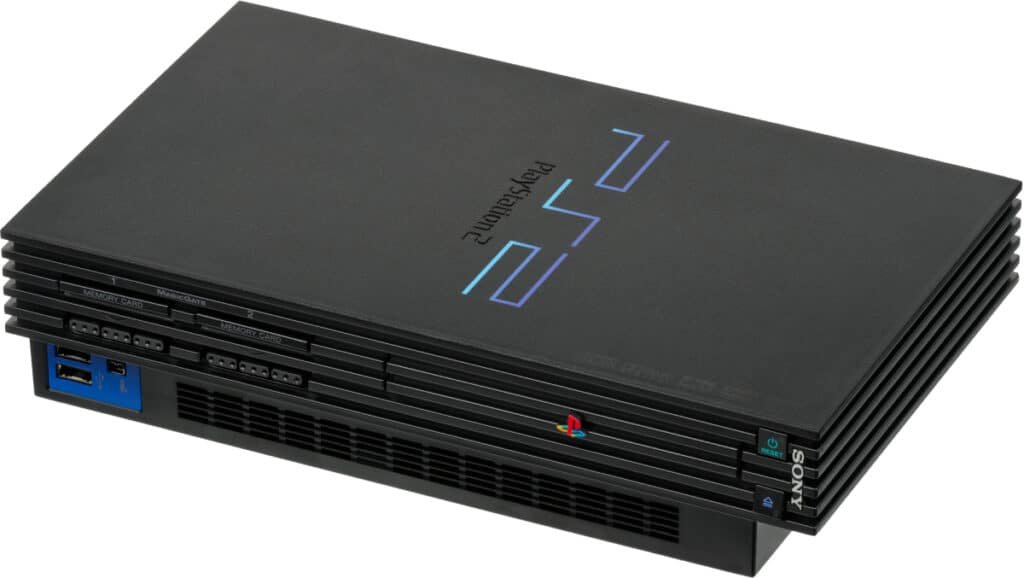
The SCPH-30000 family marked the broader worldwide PS2 rollout and established the hardware profile associated with the classic original PS2: a large black console that could sit horizontally or vertically, with a front-loading optical drive and a removable rear Expansion Bay cover.
The Expansion Bay is one of the most important distinctions in the entire PS2 hardware history. On compatible fat consoles, Sony’s Network Adapter connected at the rear and provided network connectivity. It also provided the Parallel ATA/IDE interface and power connection used by supported internal hard-drive configurations. Sony’s official 40 GB PlayStation 2 HDD was sold in Japan and North America and was included with the Linux kit in Europe, although regional support and software usage varied.
The SCPH-30000 and related early international fat families helped standardize this approach. These systems were the foundation for official online services, the PlayStation 2 Linux Kit in supported territories, and games that could use the hard drive, most famously Final Fantasy XI in applicable regions.
Collectors should remember that early fat consoles are now more than two decades old. Their optical drives, tray mechanisms, fans, memory-card slots, controller ports, and internal power hardware may have experienced very different levels of use. The family number identifies a broad hardware era; it does not guarantee the condition of an individual console.
SCPH-39000: The Revised Fat Workhorse
The SCPH-39000 series arrived as a later fat-console refinement around 2002–2003. It retained the classic chassis and Expansion Bay while reflecting Sony’s ongoing effort to reduce cost and revise internal design.
This family is often encountered in North America as SCPH-39001 and in PAL territories under related regional suffixes. Its practical appeal is straightforward: it is still a full-size PS2 with the rear expansion capability that distinguishes fat systems from Slimline systems.
The SCPH-39000 family is also remembered for changes involving cooling and internal component organization. Documentation and preservation databases track multiple board-level revisions within the same broad model family, so an SCPH-39000 label should not be treated as a complete motherboard identification. Sony revised PS2 components throughout production, sometimes without changing the outward family name.
For a buyer, the important questions are less about chasing a single “perfect” revision and more about the intended use:
- Do you want the Expansion Bay for official-style network and hard-drive functionality?
- Is the optical drive reading both CD-based and DVD-based games reliably?
- Does the console include its power cable, AV cable, controller, and original Expansion Bay cover?
- Is the console from the correct region for your software library and display setup?
SCPH-50000: The Final Major Fat PS2 Family
The SCPH-50000 series was the final major original-chassis PlayStation 2 family before Sony moved to the Slimline design. It is an important landmark for collectors because it combines the mature fat-console form factor with later production refinements.
The family retained the rear Expansion Bay, allowing use with compatible official Network Adapter and hard-drive setups. It also introduced or standardized several visible changes depending on region and submodel, including an integrated infrared receiver for Sony’s DVD remote ecosystem. The i.LINK port present on earlier fat designs was removed from the SCPH-50000 generation, a meaningful change for collectors interested in the short-lived PS2 i.LINK feature and games that supported it.
Some Japanese SCPH-50000 variants were associated with PlayStation BB Unit packages. These combined network and storage-oriented accessories for Sony’s Japanese broadband and online initiatives. They should not be confused with every SCPH-50000 console sold worldwide; bundles and regional packages often contained accessories that were not standard in all markets. Sony’s current Japanese accessory compatibility page still distinguishes SCPH-50000-series variations, including models associated with the PlayStation BB Unit.
The SCPH-50000 is often attractive for buyers who want an original PS2 experience, a disc tray rather than a top-loading lid, and access to the fat console’s Expansion Bay ecosystem. It is not automatically superior to every other PS2, however. It is physically larger, usually louder than later Slim systems, and its age means that optical-drive health remains more important than the model number alone.
PS2 Fat vs. PS2 Slim
The choice between PS2 fat and slim is not simply old versus new. The two form factors prioritize different features.
| Feature | PS2 Fat models | PS2 Slim models |
|---|---|---|
| Major ranges | SCPH-10000 through SCPH-50000 | SCPH-70000 through SCPH-90000 |
| Size | Larger, heavier chassis | Much smaller and lighter chassis |
| Disc mechanism | Front-loading tray | Top-loading lid |
| Power supply | Internal power supply | External brick on most Slims; internal power supply returns on SCPH-90000 |
| Network connectivity | Requires compatible Network Adapter accessory | Ethernet integrated into the console; some early regional models also include a modem |
| Expansion Bay | Present on later fat families such as SCPH-30000 through SCPH-50000 | Absent |
| Official internal HDD path | Available on compatible fat systems using Network Adapter and Expansion Bay | Not available as a standard official internal installation |
| i.LINK | Present on some earlier fat generations, removed by SCPH-50000 | Not present |
| Storage and accessories | Better fit for official HDD-era ecosystem | Better fit for compact disc-based play |
| Typical collector appeal | Full original PS2 form factor, accessory expansion, hardware history | Space-saving design, integrated Ethernet, later production dates |
Neither form factor is universally “better.” A collector building a historically complete PS2 setup may prefer a later fat console with an Expansion Bay. A player with limited shelf space may prefer a Slim. Someone who wants the simplest late-production unit may consider an SCPH-90000, while someone interested in official HDD-era functionality should look primarily at compatible fat consoles.
PS2 Slim Models and Hardware Revisions
SCPH-70000: The Slimline Redesign
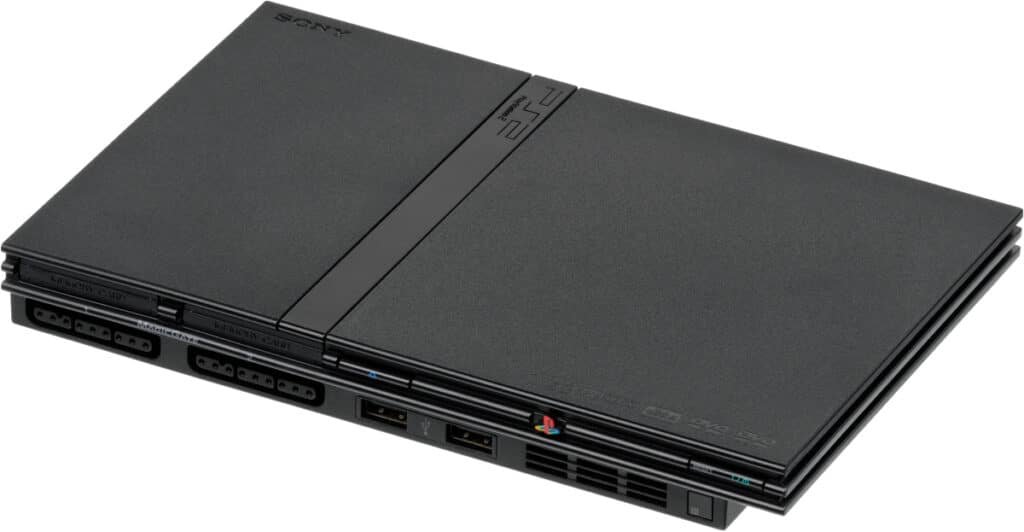
Sony introduced the first PS2 Slimline family, SCPH-700xx, in 2004. The redesign was one of the most dramatic in console history: Sony reduced the bulky original chassis to a compact top-loading system while preserving PS2 game support and PS1 backward compatibility.
The new console was smaller, thinner, and generally quieter than the fat PS2. It included built-in Ethernet networking, eliminating the need for the external Network Adapter required by fat consoles. In certain markets, the Slim also included an integrated analog dial-up modem, which is why rear-port layouts can differ among SCPH-700xx regional variants.
The trade-off was the loss of the standard rear Expansion Bay. A conventional internal 3.5-inch hard-drive setup was no longer part of the Slimline design. The earliest SCPH-70000 architecture retained networking hardware related to the prior Network Adapter design, which is relevant to advanced preservation and modification communities. That does not mean every early Slim should be treated as an HDD-ready machine; official consumer support did not provide a standard internal hard-drive installation path for the Slimline.
For everyday use, the first Slimline PS2 is easy to identify:
- It has a small horizontal chassis with a hinged top disc lid.
- It has integrated Ethernet at the rear.
- It uses an external power adapter.
- It lacks the fat console’s rear Expansion Bay.
SCPH-75000 and SCPH-77000: Integration and Internal Changes
The SCPH-75000 and SCPH-77000 Slim families continued Sony’s internal redesign work. Externally, they resemble earlier Slim systems. Internally, however, Sony consolidated functions and changed board layouts.
One significant enthusiast-facing difference is the storage interface. On early SCPH-700xx Slim systems, the networking design retained hardware relationships that preservation communities have studied for external IDE experimentation. By the SCPH-75000 generation, Ethernet functionality had been integrated more deeply into the I/O processor design and the earlier ATA/IDE disk interface was removed. This is an important technical distinction, but it should not be overstated: Sony did not market these Slim systems as official internal-HDD consoles.
For collectors and players using stock hardware, the more practical differences are physical condition, included power supply, disc-lid behavior, and regional compatibility. A later Slim is not necessarily more reliable merely because it is newer. It may have fewer years of use, but every example has its own service history.
SCPH-79000: Further Slimline Miniaturization
The SCPH-79000 series arrived in 2007 as another compact Slimline revision. It retained the external power brick and continued Sony’s program of reducing size, weight, and component count. Preservation references generally identify it as the smallest external-power Slim generation.
For buyers, the SCPH-79000 can be appealing because it is a late-life production model in a very compact package. It remains a disc-based console with a top-loading lid, built-in Ethernet, and no standard official internal hard-drive expansion route.
Check the power adapter: When buying an SCPH-79000, verify that the correct external AC adapter is included. Power supplies are not interchangeable merely because the connector appears similar. Read the console label and adapter label together, and use the correct region-appropriate input hardware.
SCPH-90000: The Final Retail PS2
Sony launched the SCPH-90000 family in late 2007. This was the final major PlayStation 2 hardware revision and remained in production until Sony ended PS2 manufacturing in 2013.
The most visible engineering change was the return of an internal power supply. Earlier Slimline systems used an external brick, but the SCPH-90000 put the power hardware back inside the console. That reduced cable clutter while retaining the compact Slim form factor. Sony’s official manuals include regional SCPH-9000x variants, including SCPH-90002, SCPH-90003, and SCPH-90004 documentation.
The final PS2 family is often appealing to players who want the smallest practical all-in-one PS2. Still, it is not a universally ideal choice for every enthusiast. Later board and BIOS variations can affect the behavior of specific unofficial software methods, while the lack of the fat Expansion Bay limits official HDD-oriented use.
Sony continued selling the PS2 well after the PlayStation 3 launched. In 2009, Sony reduced the North American PS2 price to $99.99, underscoring the system’s unusual longevity. Production eventually ended in 2013, closing one of the longest retail hardware lifecycles for a major home console.
Special Editions, Colors, and Bundles
Special editions deserve separate treatment from major PlayStation 2 hardware revisions. A console’s color, packaging, or bundled game does not necessarily indicate a fundamentally different motherboard, optical drive, or power design.
Sony released PS2 systems in several colors and special packages over the console’s life. Depending on region, these included silver, white, red, blue, pink, ceramic-white, satin-silver, and franchise-branded versions. Japan generally received the widest variety of color variations, while other regions often saw more limited bundle-focused releases.
Examples of collector distinctions include:
- Colored fat PS2 systems, particularly Japanese variants.
- Ceramic White and Satin Silver Slimline consoles.
- Franchise bundles packaged with games, controllers, stands, memory cards, or DVDs.
- Japanese PlayStation BB Unit-related packages tied to network and hard-drive services.
- Later slim bundles sold during the PS2’s budget-price years.
A special edition should be evaluated on two separate axes:
- Cosmetic and packaging value: color rarity, original box, matching controller, inserts, manuals, and sealed accessories.
- Technical identity: the SCPH family, regional suffix, motherboard era, drive condition, and power arrangement.
A white SCPH-70000 Slim, for example, may be visually more collectible than a standard black unit, but it is still part of the same broad technical generation unless its exact model label indicates otherwise.
PSX DESR Series: Not a Standard PS2 Revision
The PSX, identified by DESR model numbers rather than SCPH numbers, was not a normal worldwide PlayStation 2 revision. It was a Japan-only Sony digital-media device that combined PS2 game functionality with a hard-disk-based digital video recorder and DVD-recording features.
Sony announced the first models in October 2003 and launched the DESR-5000 with a 160 GB hard drive and the DESR-7000 with a 250 GB hard drive in Japan on December 13, 2003.
The PSX is notable for its white industrial design, XrossMediaBar-style interface influence, integrated TV-recording role, and unusual position between a game console, DVD recorder, and home-media hub. It can play PS1 and PS2 games, but it should not be treated as an ordinary PS2 console model when building a global SCPH chronology.
Later DESR variants expanded the PSX line, but all remained Japan-focused products with region, tuner, language, repairability, and collector-support considerations distinct from standard PS2 hardware.
Compatibility and Network Context
Every standard retail PS2 family was designed to play PlayStation 2 game discs, and the platform is broadly known for backward compatibility with original PlayStation games. In practice, software regions, video standards, disc condition, accessory requirements, and a small number of title-specific edge cases can still matter.
PS1 and PS2 Game Support
Standard PS2 systems support PS1 discs as part of the console’s original design. The console’s memory-card slots are also generation-specific:
- PS1 games save to original PlayStation memory cards.
- PS2 games save to PlayStation 2 memory cards.
- A PS2 memory card cannot substitute for a PS1 memory card when saving PS1 games.
For collectors importing games, the main complication is regional locking. A North American PS2 is intended for North American-region discs, a Japanese PS2 for Japanese-region discs, and PAL consoles for their corresponding regional software. Modifications and alternative boot methods exist in enthusiast communities, but they are unofficial, can vary by model and BIOS version, and may introduce compatibility, legal, safety, or preservation concerns.
Online and Network Functionality
PS2 online support evolved across the hardware lifecycle:
- Fat PS2 consoles used a separate Network Adapter.
- Slimline PS2 consoles integrated Ethernet.
- Some early Slimline regional versions also included a dial-up modem.
Original commercial PS2 online services are largely no longer available in their original form. Community-operated replacement services and private servers exist for certain games, but support is game-specific and should not be assumed to work on every title, region, or console configuration.
Official Hard-Drive Support
The most important storage distinction is between later fat PS2 models and Slimline systems.
Compatible fat consoles with the rear Expansion Bay, especially SCPH-30000 through SCPH-50000 families, can use the official-style Network Adapter pathway for compatible internal IDE hard drives. Sony’s official 40 GB HDD and Network Adapter ecosystem supported specific software and services, including Final Fantasy XI and the PS2 Linux environment in relevant markets.
Slimline models include Ethernet but lack the standard Expansion Bay and were not designed for the same official internal hard-drive installation. Enthusiast modifications can change what is technically possible on some specific models, but those projects are not universal, official, or risk-free.
PS2 Collector Guide: What to Check Before Buying
The model number matters, but the physical condition of a 20-plus-year-old console matters just as much.
Start With the Label
Ask for a clear photo of the SCPH label before buying. Confirm:
- The full SCPH number and suffix.
- The console’s intended region.
- Voltage and power information.
- The serial-number label has not been removed or damaged.
- The exterior matches the claimed model family.
Avoid listings that say only “PS2 console” if the seller cannot provide a label photo. The difference between an SCPH-39001 fat console and an SCPH-79001 Slim is not cosmetic; they have different storage, power, disc-loading, and networking arrangements.
Inspect the Optical Drive History
The optical drive is often the most important functional variable in a used PS2.
A proper test should ideally include:
- A PS2 DVD-based game.
- A PS2 CD-based game, where available.
- A PS1 disc if PS1 compatibility matters to you.
- Multiple disc insertions and eject cycles on fat systems.
- Smooth lid closure and stable disc detection on Slim systems.
A console that plays one clean DVD is not necessarily a fully healthy console. Reading CD-ROM and DVD-ROM media can stress different parts of the optical system. At the same time, avoid assuming every reported read problem has the same cause; discs, contamination, aging components, mechanical wear, and prior repair attempts can all contribute.
Check Power and Cooling
For fat models, inspect the integrated power-cable connection, fan noise, ventilation openings, and signs of overheating or heavy smoke exposure.
For most Slim models, confirm that the external AC adapter is included, authentic or appropriately specified, and matched to the console’s label. For SCPH-90000 systems, remember that the power supply is internal, so the external brick is no longer part of the setup.
Safety note: Do not open a console simply to inspect the power supply unless you understand electrical safety and have a reason to service it. Internal power components can retain hazardous charge, and improper disassembly can damage aging plastic, ribbon cables, connectors, or shielding.
Confirm Controllers and Memory Cards
Original DualShock 2 controllers are collectible and often preferable to low-cost third-party replacements, but their buttons, analog sticks, cable strain relief, and pressure-sensitive face buttons should be tested.
Memory cards should be evaluated separately from the console:
- Official 8 MB PS2 memory cards remain the most straightforward option for conventional use.
- PS1 games require original PlayStation memory cards for saves.
- Third-party cards and modern storage solutions vary widely in behavior, compatibility, and quality.
Match the Console to Your Goal
Choose based on use case rather than internet rankings:
| Buyer goal | Sensible PS2 direction |
|---|---|
| Official HDD-era experience | Compatible fat PS2 from SCPH-30000 through SCPH-50000 range, plus appropriate accessories |
| Smallest everyday disc-playing setup | SCPH-79000 or SCPH-90000 Slim, subject to condition and regional fit |
| Early hardware collecting | Japanese SCPH-10000, SCPH-15000, or SCPH-18000, with careful accessory and region research |
| Original large-console aesthetic | SCPH-39000 or SCPH-50000 family |
| Integrated Ethernet without external Network Adaptor | SCPH-70000 through SCPH-90000 Slim |
| Japan-only Sony media-hardware collecting | PSX DESR series, with awareness that it is not a standard PS2 revision |
Frequently Asked Questions
How do I identify my PS2 model?
Look for the sticker or printed label on the underside or rear area of the console. It will list an SCPH number such as SCPH-39001, SCPH-50004, SCPH-70001, or SCPH-90004. The first part identifies the hardware family; the suffix helps identify the regional version.
Which PS2 models support the official hard drive?
Later fat PS2 families with the rear Expansion Bay, principally SCPH-30000 through SCPH-50000 systems, are the standard platform for Sony’s Network Adaptor and internal HDD ecosystem. Slim models have built-in Ethernet but do not include the normal official internal hard-drive route.
Is the PS2 Slim better than the original PS2?
It depends on your criteria. Slim models are smaller, lighter, and include Ethernet, while fat systems offer the Expansion Bay needed for the official HDD ecosystem. A Slim is often better for compact disc-based play; a compatible fat PS2 is better for collectors interested in original expansion and storage hardware.
Are all PS2 consoles backward-compatible with PS1 games?
Standard retail PS2 consoles were designed to play original PlayStation games as well as PS2 games. You will still need a PS1 memory card to save PS1 games, and software-region compatibility remains relevant when importing discs.
What is the difference between SCPH and DESR?
SCPH identifies standard PlayStation hardware model families, including normal PS2 consoles. DESR identifies Sony’s Japan-only PSX digital-media device line, which included PS2 functionality alongside hard-disk recording and DVD-recorder features.
Does every PS2 Slim have an external power brick?
No. SCPH-70000 through SCPH-79000 Slim models generally use an external power supply, while the SCPH-90000 family brought the power supply back inside the console.
Are special-edition PS2 consoles different hardware revisions?
Not necessarily. Many special editions are color variants, bundles, or packaging changes based on an existing SCPH family. Always check the full model number rather than assuming a rare color means radically different internal hardware.
Which PlayStation 2 Should You Buy?
For most buyers, the right PlayStation 2 console model is the one that matches the intended library, region, accessory plans, available space, and condition budget.
Choose a compatible fat PS2, especially a later SCPH-39000 or SCPH-50000 family, if you want the classic large-console design and the option to use the official Expansion Bay ecosystem. Choose an SCPH-70000 through SCPH-79000 Slim if you value compact size and integrated Ethernet. Choose an SCPH-90000 if you want the final retail PS2 design with its internal power supply and simplified cable setup.
Most importantly, buy the condition rather than only the number. A clean, tested PS2 with a readable SCPH label, reliable optical drive, correct power hardware, working ports, and documented regional identity is usually a better purchase than a supposedly desirable revision with unknown history.
Sources
- Sony Corporation, PSX announcement press release (October 2003)
- PlayStation Japan, PS2 accessory compatibility by model
- Obsolete Sony, Complete List of All Official PlayStation 2 Models and Variants
- Wikipedia, PlayStation 2 models
- Wikipedia, Linux for PlayStation 2